
Retinoids for Acne: A Practical Guide
Retinoids for acne have been a cornerstone of dermatology for decades. A systematic review in PubMed describes topical retinoids as a first-line treatment for acne vulgaris. The Medical Letter adds that many dermatologists now recommend them first, either alone or with antibiotics, for both inflamed and non-inflamed lesions.
Sources: Topical retinoids in acne vulgaris: a systematic review (PubMed); The Medical Letter – Retinoids
How Retinoids for Acne Work
All topical retinoids normalize keratinization, the process by which skin cells shed and plug follicles. They also appear to have anti-inflammatory effects. In other words, they tackle the clogged pore that starts a pimple and the redness that follows.
Sources: The Medical Letter – Retinoids
This broad action explains their value. Before topical tretinoin arrived in 1971, available acne agents acted mainly on inflammatory lesions and did little for comedones. Adapalene followed in 1996 and tazarotene in 1997, giving doctors more choices.
Sources: The Dermatologist – Topical retinoids and acne
Comparing Tretinoin, Adapalene and Tazarotene
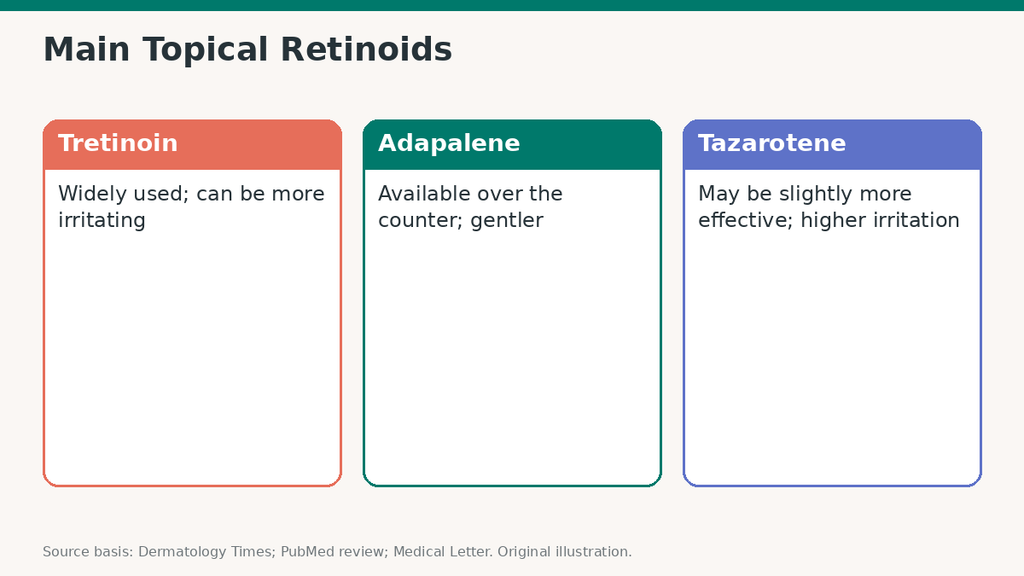
The three main topical retinoids are tretinoin, adapalene and tazarotene. A dermatologist interviewed by Dermatology Times calls adapalene a standout because it is inexpensive over the counter, may be slightly less irritating, stays stable with benzoyl peroxide and is more photostable than tretinoin. He adds that tazarotene may be slightly more effective.
Sources: Dermatology Times – Optimal topical retinoid use for acne
A systematic review of trials from 2008 to 2018 found no significant efficacy difference between tretinoin and tazarotene. However, tolerability varied. Adverse events occurred in 62% of patients using tretinoin 0.05%, compared with 19% for adapalene 0.1% and 40% for adapalene 0.3%. The authors concluded that adapalene has the best tolerability profile.
Sources: Topical retinoids in acne vulgaris: a systematic review (PubMed)
The same review made a useful point: the type of retinoid matters less than choosing a suitable strength and pairing it with an antimicrobial agent. Therefore, the best retinoid is often the one your skin tolerates and you can use consistently.
Sources: Topical retinoids in acne vulgaris: a systematic review (PubMed)
Why Retinoids for Acne Are Underused
Despite strong evidence, retinoids have been underused. A dermatology review lists several reasons: clinicians underappreciate their ability to reduce both inflammatory and comedonal lesions, and many believe that retinoids cause an initial flare before improvement. Market research cited in the review suggested that many dermatologists limit retinoids at the start of therapy for that reason.
Sources: The Dermatologist – Topical retinoids and acne
Clear counseling can solve much of this. Patients who know what to expect, including a possible adjustment period, are more likely to stay with treatment. Therefore, ask your dermatologist how your plan handles the first weeks.
Sources: Dermatology Times – Optimal topical retinoid use for acne; The Dermatologist – Topical retinoids and acne
Who Should Be Careful
Retinoids suit most people with acne, but there are exceptions. According to a dermatology chief quoted by Dermatology Times, they are the preferred initial and maintenance therapy for most patients, except those planning pregnancy or with a strong history of sensitivity to topical irritants.
Sources: Dermatology Times – Optimal topical retinoid use for acne
Pregnancy needs special caution. The Philippine Dermatological Society advises avoiding topical retinoids during pregnancy and breastfeeding, and The Medical Letter notes that adapalene is classed as pregnancy category C because adequate studies in pregnant women are lacking. Consequently, ask your doctor before starting if you might become pregnant.
Sources: Philippine Dermatological Society – Retinoids; The Medical Letter – Retinoids
Formulation also matters. One dermatologist prefers adapalene as a gel and tretinoin or tazarotene as creams, noting that the best vehicle depends on the retinoid’s preparation. However, personal skin type should guide the final choice, so follow your prescriber’s advice.
Sources: Dermatology Times – Optimal topical retinoid use for acne
How to Start Retinoids for Acne
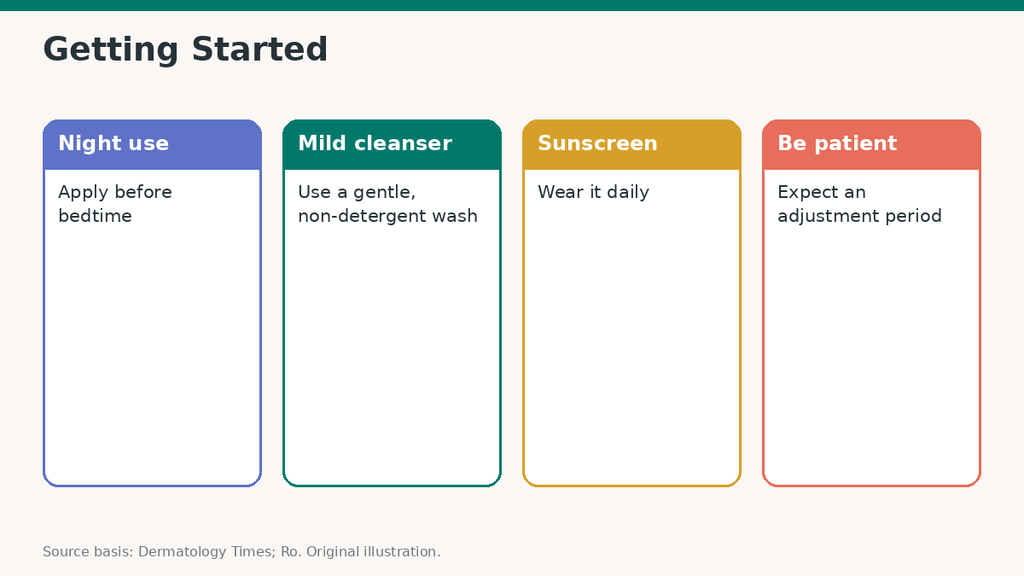
Start gently. Dermatologists suggest applying a retinoid only before bedtime, using a mild non-detergent cleanser and wearing sunscreen with an emollient base.
Sources: Ro – Retinol vs. retinoid; Dermatology Times – Optimal topical retinoid use for acne; Philippine Dermatological Society – Retinoids
Expect an adjustment period. Many clinicians worry about an initial flare, and the common belief is that acne gets worse before it improves. Clear expectations help patients stay the course. Furthermore, a Dermatology Times report found that switching from one retinoid to another triggered a second peak of side effects, so avoid changing products unnecessarily.
Sources: The Dermatologist – Topical retinoids and acne; Dermatology Times – Optimal topical retinoid use for acne; Dermatology Times – Retinoids: less may be more
Also protect your skin from the sun. The AAD notes that some acne medicines make skin more sensitive to ultraviolet rays, and it recommends a broad-spectrum, water-resistant sunscreen with SPF 30 or higher.
Sources: AAD – Tips for managing acne
Common Side Effects and How to Handle Them
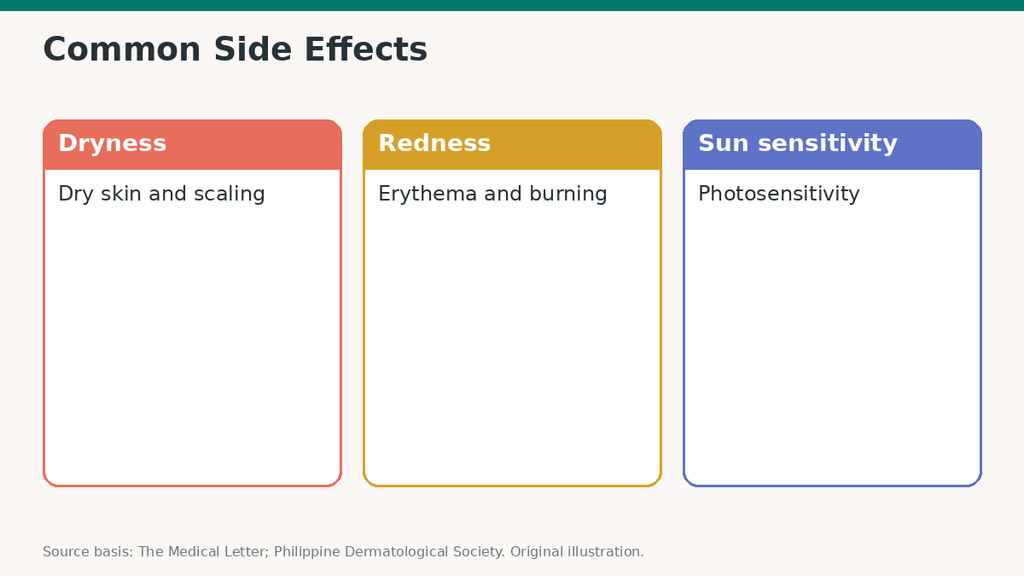
The usual side effects are dry skin, scaling, photosensitivity, redness, burning and itching. They tend to appear in the first weeks of treatment and often ease afterwards. For severe reactions, a dermatologist can prescribe supportive medicines and explain how to reintroduce the retinoid.
Sources: The Medical Letter – Retinoids; Philippine Dermatological Society – Retinoids
Retinoids With Other Acne Treatments
Combination therapy is common. The AAD guidelines recommend combining several types of topical medication, and guidelines often pair a retinoid with benzoyl peroxide. Adapalene is the retinoid that stays chemically stable alongside benzoyl peroxide. Antibiotics, in turn, should not be used alone on the skin without benzoyl peroxide.
Sources: AAD guideline update; Acıbadem International – Benzoyl peroxide; Dermatology Times – Optimal topical retinoid use for acne
Retinol is different from prescription retinoids. Sources describe retinols as generally less powerful and easier to tolerate, although their effects can be slower and milder. If retinol does not help, ask a dermatologist about adapalene or tretinoin.
Sources: Ro – Retinol vs. retinoid; Philippine Dermatological Society – Retinoids
Maintenance and Newer Options
Retinoids are valuable beyond the first few months. Dermatology Times describes them as the preferred initial and maintenance therapy for most patients, and The Medical Letter notes they can be used for maintenance. In other words, they help keep clear skin clear.
Sources: Dermatology Times – Optimal topical retinoid use for acne; The Medical Letter – Retinoids
The range is also growing. The Medical Letter has reviewed newer products such as trifarotene, a topical retinoid for acne, and a cream that combines tretinoin with benzoyl peroxide. Because availability differs by country, ask your doctor which products are accessible to you.
Sources: The Medical Letter – Retinoids
Retinoids for Acne: Quick Answers
Is adapalene a real retinoid? Yes. One source stresses that adapalene is a powerful retinoid despite its over-the-counter status, though it may cause less irritation than tretinoin.
Sources: Ro – Retinol vs. retinoid
Can teens use retinoids? According to the Philippine Dermatological Society, retinoids can be used from the teenage years, mostly for acne, when prescribed by a board-certified dermatologist.
Sources: Philippine Dermatological Society – Retinoids
Do I still need other treatments? Often yes. Guidelines favor combinations, such as a retinoid with benzoyl peroxide, because they address several causes of acne at once.
Sources: AAD guideline update; Acıbadem International – Benzoyl peroxide
- Apply at night and wear sunscreen by day.
- Use a mild cleanser and moisturize if needed.
- Avoid switching retinoids unnecessarily.
- Skip topical retinoids during pregnancy and breastfeeding unless your doctor says otherwise.
- Ask a dermatologist before combining with other actives.
Sources: Dermatology Times – Optimal topical retinoid use for acne; Dermatology Times – Retinoids: less may be more; Philippine Dermatological Society – Retinoids; Ro – Retinol vs. retinoid
When to See a Dermatologist
See a board-certified dermatologist if acne persists after consistent self-care, if irritation becomes severe, or if you are unsure which retinoid to choose. The AAD guidelines also point to isotretinoin for severe or treatment-resistant acne, which is a prescription decision.
Sources: AAD – Tips for managing acne; AAD guideline update
In summary, retinoids for acne are effective, well studied and widely recommended. Start slowly, protect your skin from the sun, stay consistent and ask for professional guidance whenever results or side effects worry you.
Sources: Topical retinoids in acne vulgaris: a systematic review (PubMed); The Medical Letter – Retinoids
Related reading: Types of Acne · Acne Treatment Options
Medical note: Educational content only, not medical advice. Consult a licensed healthcare professional.