
Spironolactone for acne is one of the best-known hormonal options for adult women. It is not an acne medicine by origin. Dermatology sources explain that it is approved for conditions such as high blood pressure, and that doctors have used it off-label for acne for decades.
Sources: MDedge – Spironolactone for adult female acne; Dermatology Times – Spironolactone for hormonal acne

This article summarizes published dermatology information. It is not a prescription guide and deliberately avoids dosing advice, because only a clinician who knows your health history can decide whether this medicine is appropriate.
Sources: MDedge – Spironolactone for adult female acne
How Spironolactone for Acne Works
Spironolactone blocks the effect of androgen hormones on the oil glands. Because androgens stimulate oil production, reducing their effect can calm hormone-driven breakouts. Dermatology Times describes it as one of four hormonal agents recommended in the AAD’s 2016 acne guidelines.
Sources: Dermatology Times – AAD 2018 spironolactone session; British Association of Dermatologists – Spironolactone patient leaflet
That recommendation carried a B rating because the evidence was inconsistent or limited in quality at the time. For comparison, combined oral contraceptives received an A rating. Even so, newer trials have strengthened the case for spironolactone.
Sources: Dermatology Times – AAD 2018 spironolactone session; EADV 2024 – Spironolactone in adult female acne
Spironolactone and Other Hormonal Options
Spironolactone is one of four hormonal agents in the AAD’s 2016 guidelines. Combined oral contraceptives earned an A rating, spironolactone and oral corticosteroids a B rating, and flutamide a C rating. In practice, doctors often combine two of these options.
Sources: Dermatology Times – Spironolactone for hormonal acne
The combination can be efficient. One dermatologist notes that prescribing spironolactone with an oral contraceptive can allow lower spironolactone dosing without losing impact, while also providing contraception and cycle control. Therefore, many clinicians offer both together to eligible patients.
Sources: MDedge – Spironolactone for adult female acne
Who May Be a Candidate
Dermatologists describe several typical candidates. These include women whose acne flares in a cycle with menstruation, women with adult-onset or persistent acne beyond the teenage years, and women on oral contraceptives who still have moderate to severe acne with a hormonal pattern.
Sources: MDedge – Spironolactone for adult female acne; Dermatology Times – Spironolactone for hormonal acne
It may also help women who have not responded to antibiotics, and those who do not want or cannot use isotretinoin. In addition, patients with polycystic ovary syndrome or excess hair growth may benefit. Spironolactone can treat acne on the face, back and chest.
Sources: Dermatology Times – AAD 2018 spironolactone session; Dermatology Times – Spironolactone for hormonal acne; MDedge – Spironolactone for adult female acne
How Long Does It Take to Work?
Patience matters. A review reports that the median time to initial improvement was about three months, with peak effects after four to six months of treatment. Another clinician stresses that it can take several months to see results and that adjustments may be needed.
Sources: MDedge – Spironolactone for acne review; Dermatology Times – Spironolactone for hormonal acne
A UK patient leaflet notes that treatment may need to continue for up to six months before the full benefit appears. Therefore, judging the medicine too early can be misleading.
Sources: British Association of Dermatologists – Spironolactone patient leaflet
Side Effects of Spironolactone for Acne
Most side effects are dose-related. Common ones include frequent urination, menstrual irregularities, fatigue, headache and dizziness, and they rarely lead to stopping treatment. Breast tenderness is also reported. Rates of adverse effects appear lower in adolescents than in adults.
Sources: MDedge – Spironolactone for acne review; Dermatology Times – AAD 2018 spironolactone session; MDedge – Spironolactone for adult female acne
Spironolactone can also lower blood pressure when you stand up, causing lightheadedness. The leaflet adds that alcohol may increase dizziness. Consequently, tell your clinician about dizziness, fainting or any symptom that worries you.
Sources: British Association of Dermatologists – Spironolactone patient leaflet

Pregnancy and Contraception
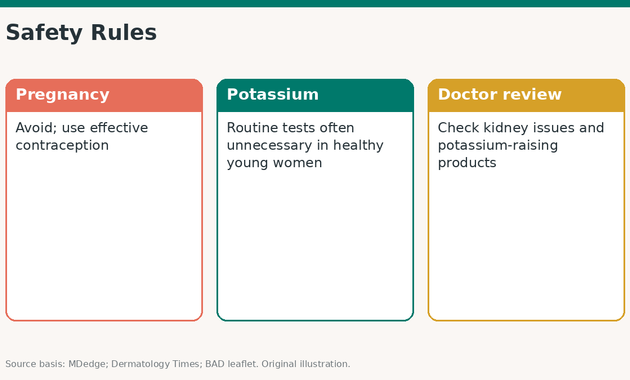
Pregnancy is the major caution. Spironolactone should not be used during pregnancy, and doctors advise effective contraception because the drug caused feminization of male fetuses in animal studies. At the same time, the AAD guidelines note that combined oral contraceptives can also help regulate menses.
Sources: MDedge – Spironolactone for acne review; Dermatology Times – AAD 2018 spironolactone session
Combining spironolactone with a combined oral contraceptive can also increase its benefit for acne and reduce menstrual irregularities. Moreover, women using progestin-only contraception may benefit from the anti-androgen effect as well.
Sources: British Association of Dermatologists – Spironolactone patient leaflet; Dermatology Times – Spironolactone for hormonal acne
Do You Need Potassium Tests?
Spironolactone is a potassium-sparing diuretic, so potassium has been a long-standing question. A 2015 JAMA Dermatology study found a hyperkalemia rate of 0.72% among 974 healthy young women taking it for acne, similar to the 0.76% baseline rate. Researchers concluded that routine potassium monitoring is not necessary for healthy young women.
Sources: Dermatology Times – AAD 2018 spironolactone session
However, clinicians still screen for risk. Doctors check for kidney problems, potassium supplements, potassium-containing salt substitutes and other potassium-raising medicines, and they may test older women or those with kidney or heart disease.
Sources: MDedge – Spironolactone for adult female acne; Medicom – AAD 2019 hormonal therapy; MDedge – Spironolactone for acne review
Counseling also matters. One dermatologist advises patients about potassium intake, including food sources, and checks for potassium supplements or potassium-containing salt substitutes before starting. Consequently, a short medication and diet review is a routine part of safe prescribing.
Sources: MDedge – Spironolactone for adult female acne
What About Long-Term Safety?
Evidence is reassuring but still evolving. A Danish registry found no increased risk of breast, uterine or ovarian cancer with spironolactone, and a conference summary says women at low risk can follow standard gynecologic check-ups. One long-term study followed patients taking it for acne for up to eight years.
Sources: Medicom – AAD 2019 acne update; EADV 2024 – Spironolactone in adult female acne; MDedge – Spironolactone for adult female acne
Spironolactone may also be continued for longer than antibiotics, which AAD guidelines advise limiting to three to four months. In a double-blind trial discussed at EADV 2024, it outperformed doxycycline for acne with minimal adverse effects.
Sources: MDedge – Spironolactone for acne review; EADV 2024 – Spironolactone in adult female acne
Spironolactone for Acne: Quick Answers
Is it FDA-approved for acne? No. It has no FDA approval for acne, so doctors prescribe it off-label, which is common in dermatology.
Sources: Medicom – AAD 2019 acne update; MDedge – Spironolactone for adult female acne
Can teenagers take it? Adverse effect rates appear lower in adolescents than in adults. However, the effects on early endocrine development are unknown, so specialist judgment is essential.
Sources: MDedge – Spironolactone for acne review
Does it work on body acne? Yes. Dermatologists report that it can help acne on the face, back and chest.
Sources: MDedge – Spironolactone for adult female acne
Questions to Ask Your Doctor
- Is my acne hormonal enough for spironolactone?
- Which contraception should I use during treatment?
- Do I need a blood test, given my health history?
- How will we judge results after three to six months?
- What other options exist if it does not work?
Sources: MDedge – Spironolactone for adult female acne; Dermatology Times – AAD 2018 spironolactone session; MDedge – Spironolactone for acne review
When to See a Dermatologist
Ask a board-certified dermatologist if hormonal acne persists despite topical care. A clinician can review your history, check for hormonal conditions such as PCOS and decide whether spironolactone, an oral contraceptive or another option fits.
Sources: MDedge – Spironolactone for adult female acne; AAD – Tips for managing acne
In summary, spironolactone for acne is an effective, well-studied off-label option for selected women, particularly those with cycle-linked or persistent adult breakouts. It needs time, careful pregnancy prevention and professional supervision, so discuss it with your doctor rather than starting on your own. Bring a list of your current medicines and supplements to that visit.
Sources: Dermatology Times – Spironolactone for hormonal acne; MDedge – Spironolactone for acne review
Related reading: Types of Acne · Acne Treatment Options
Medical note: Educational content only, not medical advice. Consult a licensed healthcare professional.