
Oral antibiotics for acne have helped millions of people with stubborn inflammatory breakouts. Dermatologists have long relied on them for moderate to severe acne. However, concerns about antibiotic resistance mean that doctors now stress careful, time-limited use.
Sources: Cutis – Oral antibiotic principles for acne

This article summarizes published guidance. It does not recommend any specific drug or dose, and it does not replace a prescriber who knows your history.
Sources: Cutis – Oral antibiotic principles for acne
When Doctors Use Oral Antibiotics for Acne
However, oral antibiotics are considered for moderate to severe inflammatory acne when rapid anti-inflammatory control is needed. They are not indicated for comedonal acne or mild papulopustular acne. Before starting, clinicians weigh benefits against risks such as resistance and microbiome disruption.
Sources: Cutis – Oral antibiotic principles for acne
For first-line treatment of moderate to severe acne, the AAD recommends oral antibiotics, specifically doxycycline and minocycline, combined with benzoyl peroxide and a topical retinoid. These drugs act against bacteria and also reduce inflammation.
Sources: Dermatology Times – Antibiotic resistance in acne; Clinical Edge – AAD guidance on antibiotic resistance in acne
Why Combination Therapy Matters
Oral antibiotics should not be used alone. Guidance states that topical retinoids should start at the same time to boost anti-inflammatory benefit, ease the move to maintenance therapy and reduce resistance risk. A two-agent regimen is often enough during the initial phase.
Sources: Cutis – Oral antibiotic principles for acne; Cutis – Path of least resistance: antibiotic stewardship in acne
Benzoyl peroxide is another key partner. It kills bacteria without causing resistance, and the AAD recommends using it whenever oral antibiotics are prescribed. One dermatologist calls adding it a low-cost step with minimal opportunity for harm and a fair to very good chance of limiting resistance.
Sources: Clinical Edge – AAD guidance on antibiotic resistance in acne; Dermatology Times – Antibiotic resistance in acne
Topical antibiotics deserve a caution too. Using clindamycin or erythromycin as the only topical treatment is discouraged because of their higher resistance potential. Fixed combinations with benzoyl peroxide can simplify the regimen and may improve adherence.
Sources: Cutis – Path of least resistance: antibiotic stewardship in acne; Clinical Edge – AAD guidance on antibiotic resistance in acne

How Long Should Treatment Last?
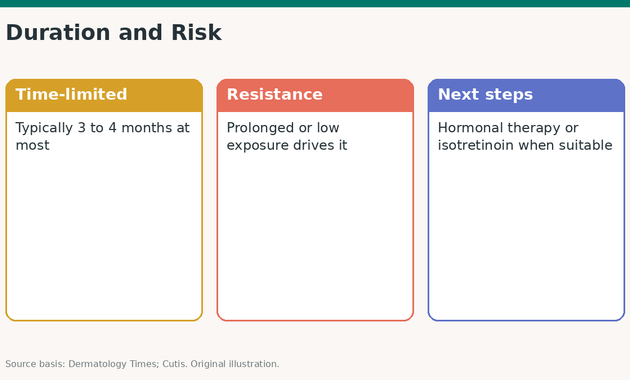
Duration is a central safety principle. The AAD and the European guidelines both advise limiting oral antibiotic courses to about three to four months where possible. Other stewardship guidance suggests stopping within 8 to 12 weeks once improvement is clear.
Sources: Dermatology Times – Antibiotic resistance in acne; Cutis – Path of least resistance: antibiotic stewardship in acne
Consequently, benzoyl peroxide and a topical retinoid should continue as maintenance after the antibiotic stops. Repeated or prolonged courses should be avoided. As a result, a plan for the end of antibiotics should exist from the beginning.
Sources: Clinical Edge – AAD guidance on antibiotic resistance in acne; Cutis – Path of least resistance: antibiotic stewardship in acne
Understanding Antibiotic Resistance in Acne
Moreover, resistance in the acne bacterium arises through selective pressure from prolonged or subtherapeutic antibiotic exposure. Laboratory resistance is well documented, although clinical treatment failure due to resistance remains rare and hard to quantify.
Sources: Cutis – Oral antibiotic principles for acne; Cutis – Path of least resistance: antibiotic stewardship in acne
Even so, minimizing unnecessary exposure is considered good practice. Stewardship does not mean withholding antibiotics. Instead, it means using them thoughtfully so they stay effective in the future. Broad-spectrum antibiotics may also disrupt skin and gut microbiota. Therefore, some experts favor narrower-spectrum options when feasible. Sarecycline, for example, has shown narrower activity in the laboratory within the tetracycline class. Likewise, experts avoid cycling between antibiotics without clear benefit.
Sources: Cutis – Path of least resistance: antibiotic stewardship in acne
Keeping the Regimen Simple
Also, simplicity improves adherence, especially in teenagers. A regimen with an oral antibiotic and a topical retinoid is usually sufficient early on. Clear instructions, realistic expectations and follow-up visits help people stay on track.
Sources: Cutis – Path of least resistance: antibiotic stewardship in acne
Sun care is also part of the plan. The AAD notes that some acne medicines make skin more sensitive to ultraviolet rays and recommends broad-spectrum sunscreen with SPF 30 or higher. Likewise, gentle skincare helps prevent irritation from topical partners.
Sources: AAD – Tips for managing acne; AAD – 10 habits that worsen acne
Doxycycline and Minocycline: What to Expect
These two drugs are the first-line oral antibiotics for acne because they act on both bacteria and inflammation. However, they are only one part of a plan. Also, the AAD notes that some acne medicines make skin more sensitive to sunlight, so sunscreen remains important.
Sources: Clinical Edge – AAD guidance on antibiotic resistance in acne; AAD – Tips for managing acne
Moreover, improvement should guide the timeline. Stewardship guidance advises discontinuing the antibiotic ideally within 8 to 12 weeks, as clinical improvement is demonstrated. Therefore, ask your doctor how success will be judged and what happens after you stop.
Sources: Cutis – Path of least resistance: antibiotic stewardship in acne
What If Antibiotics Do Not Work?
If response is inadequate, doctors consider other options. Hormonal therapy may suit selected female patients, and isotretinoin should be considered for severe, recalcitrant or scarring acne. Switching between antibiotics without clear benefit is discouraged.
Sources: Cutis – Path of least resistance: antibiotic stewardship in acne
One dermatologist at an AAD meeting argued that clinicians should move to hormonal therapy faster, partly to spare antibiotics. Spironolactone, for instance, has been compared with doxycycline in a double-blind trial discussed at EADV 2024, where it performed better with minimal adverse effects.
Sources: Medicom – AAD 2019 acne update; EADV 2024 – Spironolactone in adult female acne
Benzoyl Peroxide Safety Questions
Some patients worry about product recalls involving benzene contamination in certain benzoyl peroxide products. Cutis authors acknowledge that these recalls may have raised concerns, while describing benzoyl peroxide as a first-line option because of its bactericidal action and lack of resistance.
Sources: Cutis – Path of least resistance: antibiotic stewardship in acne
In such cases, alternatives exist. FDA-approved topical options such as azelaic acid may be used based on shared decision-making, tolerability, cost and patient preference. Therefore, talk with your dermatologist rather than stopping treatment on your own.
Sources: Cutis – Path of least resistance: antibiotic stewardship in acne
Questions to Ask Your Prescriber
- Is my acne severe enough to need an oral antibiotic?
- Which topical partners should I use at the same time?
- How long should this course last, and what comes after?
- What should I do if I see no improvement?
- Would hormonal therapy or isotretinoin be an option later?
Sources: Cutis – Oral antibiotic principles for acne; Cutis – Path of least resistance: antibiotic stewardship in acne; Dermatology Times – Antibiotic resistance in acne
Oral Antibiotics for Acne: Quick Answers
Can I use antibiotics alone? No. Guidelines advise against oral antibiotic monotherapy and recommend pairing them with benzoyl peroxide and a topical retinoid.
Sources: Clinical Edge – AAD guidance on antibiotic resistance in acne; Cutis – Oral antibiotic principles for acne
Are they right for mild acne? Generally not. They are not indicated for comedonal or mild papulopustular acne, where topical treatment is usually enough.
Sources: Cutis – Oral antibiotic principles for acne
Why does regimen simplicity matter? Simpler regimens improve adherence, especially in adolescents, and adherence strongly affects results.
Sources: Cutis – Path of least resistance: antibiotic stewardship in acne
When to See a Dermatologist
See a board-certified dermatologist if acne is inflamed, painful or spreading, or if it leaves scars. The AAD recommends professional care when self-care does not clear acne, and early treatment reduces scarring risk.
Sources: AAD – Tips for managing acne; AAD – Acne scars
In summary, oral antibiotics for acne work best as part of a combination plan, for a limited time and under medical supervision. Pair them with benzoyl peroxide and a retinoid, plan the next step early and protect future treatment options. Always tell your prescriber about other medicines you take, and ask questions whenever the plan is unclear.
Sources: Dermatology Times – Antibiotic resistance in acne; Cutis – Path of least resistance: antibiotic stewardship in acne
Related reading: Types of Acne · Acne Treatment Options
Medical note: Educational content only, not medical advice. Consult a licensed healthcare professional.